Zen-ish Thoughts About Your Internal Monastery
Life is hard. I sometimes feel the appeal of opting out, and living in the protective isolation of a monastery. These days, I feel this more and more often.
I have never lived in a monastery, and I don't have any personal friends who are monks or nuns (of any faith), but I feel comfortable making two assumptions:
- People are people, so even in a monastic setting, there will be some conflict and drama, some of it substantial, painful, and destructive.
- Nonetheless, a life surrounded by people who are exceptionally dedicated to shared values themed on tranquil cooperation, in an institution that doesn't tolerate much non-conformity, in which you have barely any personal possessions, no romantic involvements, little family contact, little contact with people who are not like-minded, no responsibility for one's own young children or aging parents, no commercial job pressures, no bills to pay, no personal finances to manage, no wondering how tomorrow will differ from today … well, that's pretty much a cheat code for reduced stress compared to those of us living outside of monasteries.
Sometimes I want that.
Out here in the real world, how does a person live with integrity, agency, and compassion in an indifferent universe and a fracturing society?
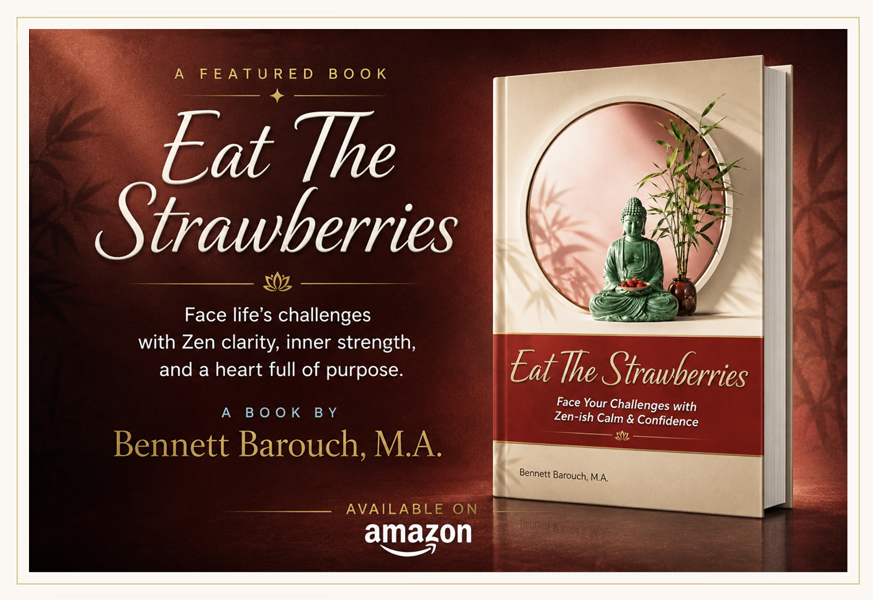
If that question interests you, I really want you to read my book, Eat The Strawberries , as it reflects my personal attempt to answer that question and others like it. At present, let's just discuss the matter at the top level.
One must:
- Ask questions of this very sort, again and again, expecting increasingly valuable answers, not the answer.
- Ask yourself. Ask people you know whose minds impress you. Ask great thinkers by reading what they have had to say.
- Contemplate philosophy.
- Study some biology, psychology, sociology, and history.
- Meditate.
- Say no.
When you contemplate philosophy (I recommend Stoicism, Existentialism, and Secular Humanism), you are sipping on thousands of years of systematic, disciplined thought about really tough subjects. Religion prescribes. Philosophy asks. Philosophy is not a bunch of meaningless academic abstractions – that's just badly taught philosophy. Philosophy is practical, applicable, useful. You have a philosophy of life right now, and are guided by it. It's just invisible and inconsistent until you start looking at it systematically, and tuning it to better align with the things you value most.
To read and contemplate philosophical thoughts is to withdraw from the immediate and urgent to focus on the important. It addresses existential anxiety by giving you frameworks to reason through your choices, rather than rules to blindly obey. It strengthens your agency instead of asking you to abdicate it. It helps you live an increasingly coherent life with intention, purpose, value, and effectiveness. Find the philosophy implicit in great literature, in contemporary op ed pieces, in social commentary.
To build a model of how to think and feel, we must first understand what we are working with. We are biological beings, and every time we pretend we are not we risk severing our ideas about self and others from the reality of who we are. We are the most socially interdependent animals on Earth, with a huge impact on each other. When you see the patterns that prevail in individuals, societies, and over historical time, you are studying and synthesizing what it means to be a human.
Because being socially interdependent is in our nature, we are stronger when we leverage it. Seek out people with whom you can talk about how you sustain your internal monasteries and what you find within them. You don't have to build the same monasteries or come to the same conclusions – and you won't. Like-mindedness lies not in complete agreement but in agreeing to take action to make your life as intentional and true to your values as possible.
The world bombards you with stimuli, demands, and algorithms designed to hijack your dopamine system, and more generally your emotions, divorced from careful conscious oversight. By sitting in silence and observing your thoughts without attaching to them, you are pulling your attention out of the stimulus overload of the modern world. You aren't running away from your problems, although it is a temporary "vacation", you are training your brain to stop reacting reflexively to them. It is a withdrawal from relentlessness so you can actually hear yourself think, pause, and produce a decision instead of merely producing a reaction. In meditation, let intuitions arise and pass without judgment. When you are done meditating, reconcile them with your rational mind or put them aside.
Your internal monastery does you no good if you don't use it, and life will keep telling you to do something other than use it. Say no. "No, as much as I would love to go to dinner with you tonight, it will have to be another time. How about next Wednesday?" Say that when your plan for tonight was to spend some time alone, relaxing, decompressing, doing something you enjoy just for you, meditating, playing piano, getting a massage. "No, I cannot work on that all day today and tomorrow as I am going to my cousin's wedding. I'll do what I can, but I'll need until Tuesday afternoon to complete it." "No, I don't want to go to that event with you because big crowds make me uncomfortable. Instead of that, is there an evening when we can have dinner together?" "No, I don't want to do <x>, because <y>", which is really to have enough time to take care of yourself.
A monastery is a sanctuary in which you are distanced from the relentless demands of ordinary life, so you can find some peace, and develop yourself with intention and concentration. It's a tool to help you shape yourself to be truer to the things you value most, the things you would want your family to admire in you and seek to emulate. A physical monastery is a device that can facilitate this. Your internal monastery is when you enter a state of mind that provides that nurturing opportunity wherever you are – in your room, in a mindful conversation with a loved one, in a hobby activity, or even at work.